
Last modified: 2026-10-24 by martin karner
Keywords: zefat | iriyat zefa | tzfat | safed | text: hebrew (black) | text: hebrew (orange) |
Links: FOTW homepage |
search |
disclaimer and copyright |
write us |
mirrors
 image by Dov Gutterman | 2:3    Emblem adopted 30th October 1958 |
See also:
Zefat (pronounced 'Tzfat') is one of the oldest towns in
Israel, known since the era of the 2nd Temple. It is situated on
mountain tops in the Upper Gallile. Pop: 16'500. The municipal
emblem was published in the official gazette (Rashumot,
Yalkut HaPirsumim), YP 631, 30 October 1958. Main flags are
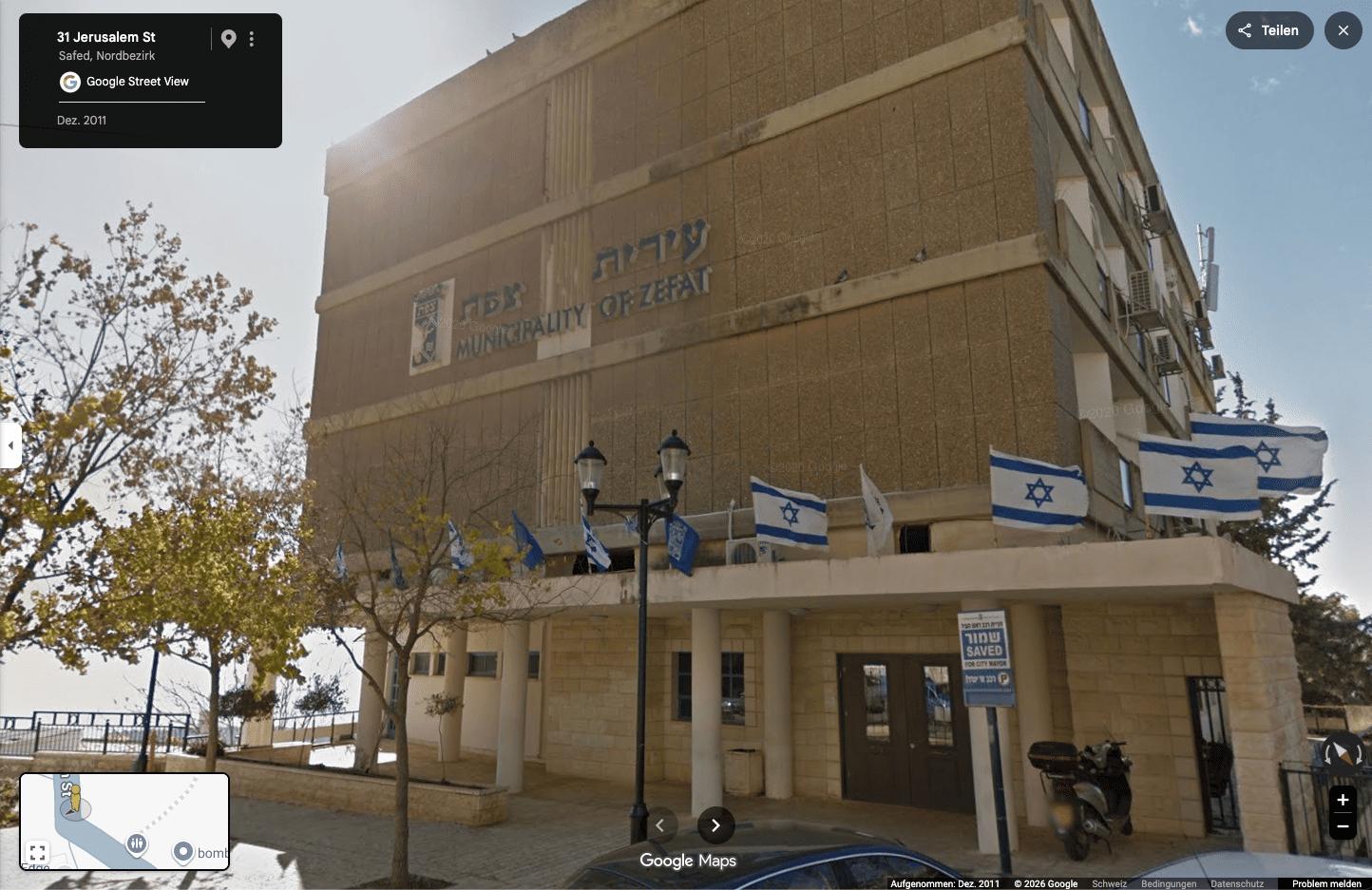
black logo on orange with inscription below, but I also spotted
blue on white, on yellow, on green and on light blue.
Source: author's own observation, 18 September 2001
Dov Gutterman, 1 October 2001
Zefat name came from the word Tzfe (observe) as it
observing from its height. There are who think that those are
initials of Tzitzit-Pe'a-Tefilin (fringe on the corners
of an upper garment – sidecurl – phylacteries) or Tzvi-Pe'er-Tif'eret
(Deer – splendor – glory).
First mentioned in the Roman era, and become famous in the 16th
century as a Jewish ceter as well as the center for Kabbalah
scholars.
Description of the emblem can be found on www.tzafonet.org.il:
The emblem appeared on a stamp issued on 2 February 1966.The outlook of the emblem resembles a Torah – a symbol of being a glorious center of Torah in the Galilee.
The inscription: [it gives the two initials mentioned above and one more Tziyur-Piyut-Torah (paint, liturgical poem, Torah)]
The pomegranate [on top] is a symbol for faith and good deeds and is one of the Torah book decorations.
[the dove] – Observing Mount Meron.
[the wavy lines] – Observing Kinnereth sea [Sea of Galilee]
The Olive – Zefat area is known for its olive plantations, The Galilee olive oil is famous in its quality and was in use in the Holy Temple.
[painter pedestal] – Many artists were assembled in Zefat due to its beauty and fine weather. Symbol for Qiryat HaAmanim (Artists Town [part of the city])
Dov Gutterman, 2 May 2005
Note that it reminds us of a Sephardic Torah Scroll, which
looks (at least on the outside) quite different from the
Ashkenazic Torah Scrolls most American and European Jews are used
to seeing. However, Ashkenzaim often have
"pomegranates" on their scrolls as well.
Nathan Lamm, 4 June 2006
♦ History of Safed (zefat.muni.il, Hebrew [retrieved] | English translation)
 | 2:3  |
 | 2:3 |
|||
 | 2:3 |
 | 2:3 |
images by Dov Gutterman
.jpg)
(source)
♦ photo
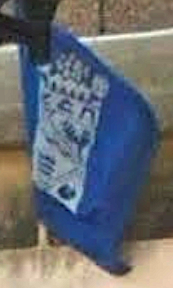
The emblem consists of a rectangle with a fringed top, resembling a Sephardic Torah scroll. The body of the emblem is divided into squares by double lines; within the squares are depictions of an olive branch, a colour palette, a bird and waves. At the top of the emblem, the name "Safed" appears in yellow, surmounted by Torah motifs in the shape of pomegranates. The dominant colour of the emblem is dark blue. Sometimes the emblem is depicted with both the olive branch and the colour palette in colour, and sometimes only the colour palette is shown in colour.
Symbolism:
The emblem's shape, modelled on a Torah scroll, symbolises the city's history as a significant centre of Torah study and one of the four Holy Cities. The motifs featured on the emblem are intended to symbolise the city's uniqueness and its geographical location:
The pomegranate motifs – intended to form the shape of a Torah scroll, but also symbolising faith and good deeds. The dove – symbolises Mount Meron, which the city overlooks. The waves – symbolise the Sea of Galilee, which the city overlooks. The olive branch – symbolises the olive trees characteristic of the Galilee region and the Galilean olive oil that was used in the Temple. The colour palette – symbolises the city's beauty and its artists' quarter.
(Translated with DeepL.com)

zefat.png)