
Last modified: 2026-10-10 by martin karner
Keywords: ashkelon | iriyat ashkelon | coat of arms (column: proper) | coat of arms (stars: orange) | coat of arms (stars: 6) | coat of arms (cogwheel: grey) | text: hebrew (black) | text: hebrew (white) |
Links: FOTW homepage |
search |
disclaimer and copyright |
write us |
mirrors
![[Municipality of Ashqelon (Israel)]](../images/i/il-asqln2.gif) 2:3 2:3   image by Dov Gutterman Coat-of-arms adopted 16th April 1959 ♦ photo |
![[flag]](../images/i/il-ashkelon.png) (source) |
See also:
The municipality of Ashkelon is situated in the southern shore
plain about 55 km south of Tel Aviv.
It is a very old city known from the biblical era, first
mentioned in ancient Egyptian scrolls dating from 1900 BC.
Ashkelon is also mentioned in the famous David's grief on
Jonathan. It was re-established in 1948 and has 98'000 inh. (July
1997).
The city has an official emblem and and unofficial flag, the
emblem on an orange field.
Source: letter from Mrs. D. Tzuriel, Events and Tourism
Department, Municipality of Ashkelon.
Dov Gutterman, 15 August 2001
The municipal emblem was published in the official gazette (Rashumot),
YP 663, 16 April 1959.
Dov Gutterman, 4 September 2001
Ashkelon, as many other municipalities in Israel, doesn't use a
specific color for its flag, but uses many backgrounds to its
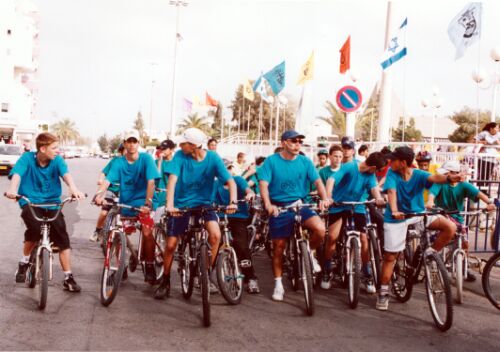
emblems. In a photo at
www.ashkelon.muni.il [retrieved],
one can see flags in white, orange, yellow, blue and purple.
The official website [2005 version not archived; newer version see below] also gives an explanation to the
emblem: "The emblem of the City of Ashkelon express the vision of its
founders: The new city which combines tourism and industry and looks
forward to the future. In the emblem there are five stars which
are the five neighborhoods of the city; a marble column with
capitol – symbol to Ashkelon antiquity; a cogwheel – the
industrial plants in the city; see waves are its magnificent
beaches and the film represents the plan of Ashkelon as Israel's
movie city [plan that was never realized, D.G]. All of that on
the background of Ashkelon's sea blue and sky light blue, finds
its expression in the city emblem."
Dov Gutterman, 8 April 2005
![[Municipality of Ashqelon (Israel)]](../images/i/il-asqln.gif)
image by Dov Gutterman
![[Municipality of Ashqelon (Israel)]](../images/i/il-asqln1.gif)
image by Dov Gutterman
![[Municipality of Ashqelon (Israel)]](../images/i/il-asqln3.gif)
image by Dov Gutterman
image by Dov Gutterman
![[CoA]](../images/i/il-ashkelon).png) (source) |
![[CoA]](../images/i/il-ashkelon)2.png) (source) |
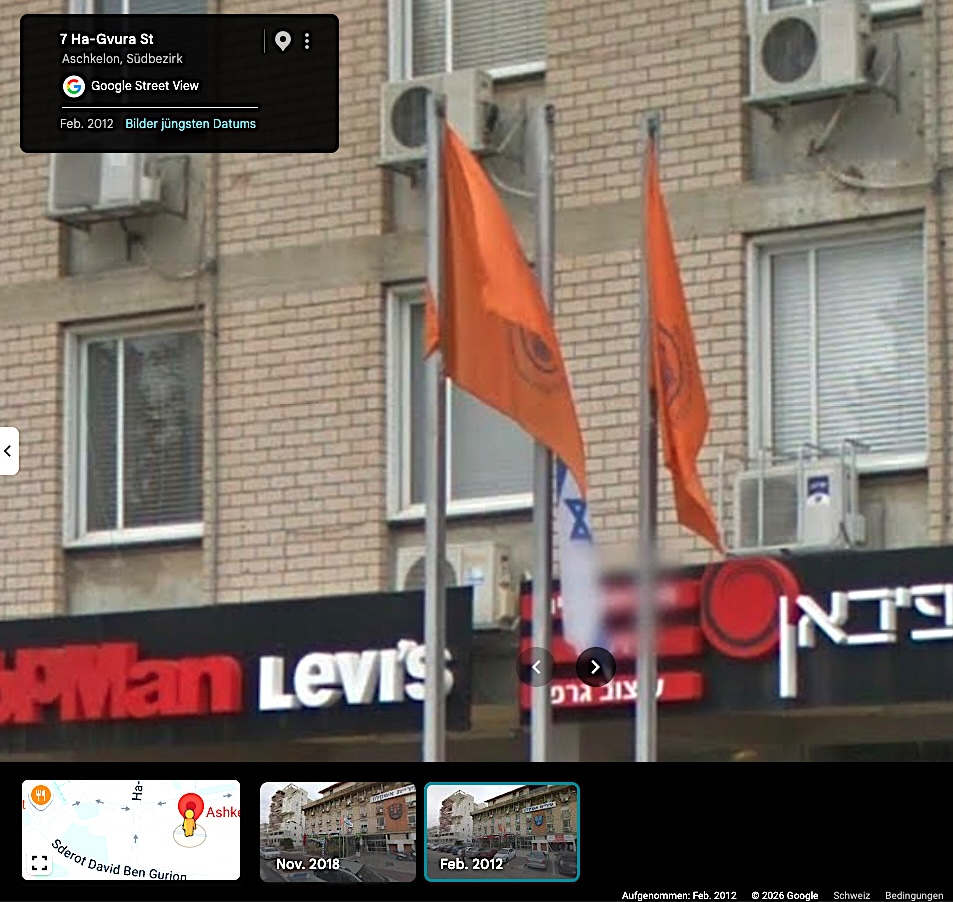
♦ photo (2011) source
♦ photo (2017)
From the municipal website (in Hebrew):
The coat of arms of Ashkelon embodies the vision of its founders – a new city that combines tourism and industry and looks to the future.
The coat of arms was designed by Ashkelon-based artists Mordechai Krubitsky and Shmuel Tepler, new immigrants and art teachers who lived in Migdal. The coat of arms was approved in 1951.
Elements of the coat of arms:Five stars – symbolising the city's five neighbourhoods A marble column with a capital – symbolising Ashkelon's antiquities A cogwheel – representing the city's industrial enterprises Waves – representing its spectacular beaches The film reel – symbolising Ashkelon's designation as Israel's "City of Film".
All these elements, set against the backdrop of Ashkelon's clear blue sea and sky, are reflected in the city's coat of arms.
(Translated with DeepL.com)
![[CoA]](../images/i/il-ashkel)2021.png)
From Hebrew Wikipedia:
In 2021, as part of the city's rebranding process, a new emblem was designed which, alongside the old emblem, featured colourful geometric shapes flowing like ocean waves. The shapes were designed to resemble computer pixels and create silhouettes symbolising the city's development. The colour scheme, together with the wave-like shapes, expresses the human and multicultural mosaic of the developing city and symbolises a promising, youthful and diverse future.
(Translated with DeepL.com)



3.jpg)

4.jpg)